Desperate English Housewife in Washington, chapter 512

My Expat Blog Interview

I haven’t done a little expat interview for a while, but this one was pretty darn fun to do.

Keeping it real, Desperate English Housewife stylie ;)

Keeping it real, Desperate English Housewife stylie 😉

Some enticing extracts for you!

‘I had a nagging fascination with things like Glee, Miami Vice, Fame, The Wire and Desperate Housewives and I kind of wanted to see if any of it is true. (Between you and me, some of it is).’

‘For me, the ‘job’ is being an expat and having a whole host of experiences. That’s a rich and rewarding CV/resume in itself.’

‘I love seeing things with new and childlike eyes. I was like this in New York: ‘Ooh, look at that Philly Cheese Steak Hot Dog thing on the pavement next to the hole in the ground with steam coming out! It’s so New York!’’

‘My top tips are just connect, don’t be shy, be open, don’t close your eyes, heart or mind to new experiences or opportunities. Don’t make excuses. Don’t judge. Go out there, do something. Turn off the TV and do something more interesting instead (now, who said that on British TV in the 1980s?). Well, they were right. Do that.’

You can read it in full here 🙂

Posted in Travel | Tagged , , , , , , , , , | Leave a comment

Desperate English Housewife in Washington, chapter 511

Taking the piss UK style

How we Brits love to take the piss out of each other, out of events, out of everyone else, and out of ourselves.

Taking the piss – one of the things Americans find hardest about the Brits is our sense of humour. It is obviously different and is mainly based on irony, sarcasm and an in-built desire to “take the piss”. This has nothing to do with urine, but simply means making fun of someone.’ (From The Effing Pot).

Sometimes I do find that this piss-taking British-stylie sense of humour that I am partial to (maybe that’s why I love Ricky Gervais) is not always so easy for my American friends to understand. It’s really like a form of endearment, maybe because sometimes we Brits actually struggle to emote exactly how we feel.

;)

😉

The differences in our senses of humour and our approach to each other still fascinates me. Some British bloke told me this week something that went a bit like this: ‘Americans think that there is a time and a place for comedy, and that’s why they write excellent comedy shows because it is the right place for that to happen. Otherwise, forget it – making jokes, taking the piss, having a laugh about something – not done.’

Another chap, this time American, told me this when discussing the subject: ‘We are such prudes about things. We don’t always remember to laugh at stuff, especially ourselves. And we’re totally fine with guns and murder and violence depicted in a PG movie, but heaven forbid there be a breast on-screen. We have issues and I don’t think we get the irony of that when we think we’re so progressive.’

Boobs and guns aside, I don’t think the issue of Americans not getting irony really exists anymore – much of their great comedy is dripping in it. It’s the taking the piss / being sarcastic / using an insult to be affectionate thing that I don’t think Americans sit very comfortably with. And, you know, it’s quite a strange way to bond with someone if you think about it!

Think of familiar British greetings such as: ‘Hi, mate. Who ate all the pies, hey?’ (I can see that can perceived as being just plain rude!)

Anyway, whatever your thoughts on it, this is an extract from one of my favoutite commentaries on the subject. It’s from a blog called From Sheep to Alligators….

I think there are 3 ways that irony can be misunderstood or cause confusion when a Brit uses it here:

1. It is being used in a context that is appropriate in a British context, but simply not done in the USA.

2. Although “taking the piss” is seen as fun in the UK, there is an ever-present danger of you being perceived as being mean-spirited in the USA.

3. Generally speaking, Americans are much more serious in their approach to life, their beliefs, and themselves than the Brits. It’s actually quite rare for an American to be seen laughing at their own foibles, in my experience, so they are suspicious of others doing it.

To avoid problems, many Americans who use irony will often “signpost” it – they will add an “only joking” to the end of an ironic statement (which seems to defeat the point of irony to me!)

There are, of course, positives to the American not-taking-the-piss approach in that there is far less of the negative dragging down that can happen when people use humour to ridicule people in the UK.

Sometimes.....

Sometimes…..

Much of this very blog you are reading now is based on taking the piss out of either us Brits or my American chums. Gentle jibes, you know. ‘Tis the British way embedded in my nature, and no offense is meant, don’t ya know!

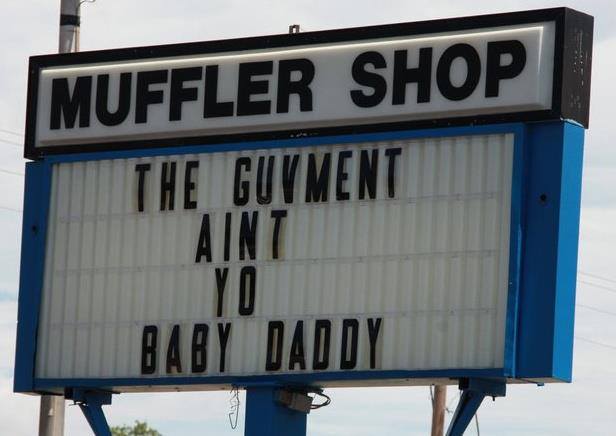
Real signs in the USA

🙂

realsign

realsignhilary

Posted in Travel | Tagged , , , , , , , , , , , , , , , | 2 Comments

Desperate English Housewife in Washington, chapter 510

See ya Halloween

Well, that’s it. Halloween is over. Next up: Thanksgiving. It feels like from Halloween to New Year it’s just a bunch of partying and eating in America-land!

I have decided that everyone should really dress up as they wish every day. Americans seem to relish this dressing up malarkey and go for it much more so that us Brits. I think our British reserve kicks in somewhat. I don’t even know what I’m dressed up as in this picture, but it’s something kind of hippy/cowgirl/Native American. Kinda. 🙂

I will be interested for next year’s Halloween, back in Blighty. I have a feeling it will be somewhat tamer and some of those spotty youths will be round asking for a quid, or else they’ll lob an egg at the windows….

Halloween!

Halloween!

Reflections on the UK, part 4

Here is the final installment of American blog reader Rebecca’s visit to the UK.

You can catch up on the previous posts here if you missed out!

The next day I take another day trip, this time to the historic town of Arundel (though I nearly miss getting off the train as I don’t realize you have to press a button to get the door to open). It’s a beautiful, quaint town which has apparently had a town crier since 369 AD, and parts of its castle date to 1068. The castle is absolutely amazing, both outside and in (where a guard cheerfully tells me that “If you don’t have a ticket, we chop your head off”). What’s even more amazing is the Duke of Norfolk still lives here, and the tour takes us through elaborate guest rooms where he still entertains. Outside, the gardens are some of the prettiest I’ve ever seen, and make you feel like you’re wandering through some sort of medieval fantasy world. How awesome to have preserved such an amazing place.

Wow. I need to go here!

Wow. I need to go here!

I spend the train ride back to London reading about the Scottish independence referendum, which is taking place today. I have mixed feelings about it. Since my country was born out of seeking independence from Britain, I can hardly begrudge the Scots from wanting to do the same. But I love Britain and don’t want it to break up. (And it would kinda feel like my parents were getting a divorce.) Either way, though, it will be a democratic and pretty peaceful process. The Scots won’t have to fight a war or go on hunger strikes to win their independence, but merely ask for it. And that’s something Britain should be proud of.

When I get back to my friend’s London apartment that night, I am eager to watch the news about the referendum. However, they’re both out, and for the life of me I cannot figure out how to turn on their TV. I press pretty much every button combination on the remote without success. Finally, in desperation, I swallow my pride and text her husband for help, who responds that he’ll be home in ten minutes, at which point he somehow gets it to work in a matter of seconds. We stay up late to watch the news. The results will be announced around 6:00 am the next morning. I wonder what it’s like to go to bed not knowing if your country will still be together the next morning. I hope it will be.

The next morning when I wake up, he’s taken pity on me and left the news on before leaving for work. Scotland has voted to stay in the UK! Yea! I text the few Brits I know in England to say congratulations. I think I am more excited than they are. I feel like we should all be wearing Union Jack clothing and singing the national anthem in celebration. But the Brits don’t generally go in for that sort of showy display of patriotism; they play it cool. So I sing what I can remember of “God Save the Queen” in my head as my own private celebration and tribute.
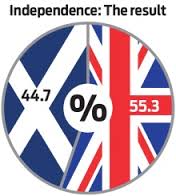
The result

The result

Today my British friend from DC, who arrived last night in London to visit family for a few weeks, and I are a meeting up to travel together for a few days. We’d planned to go south, but can’t find an affordable place to stay in any of the cities or towns we look into. Eventually we find a place in Liverpool, and so we head north instead.

It will take us a few hours to get there by train, so we become intimately acquainted with several train stations along the way. “Well, we sure haven’t seen anywhere beautiful yet,” my friend remarks. “Everywhere in England is beautiful,” I say fondly, staring out the window. He looks at me pityingly. “You really are an Anglophile, aren’t you? Usually that can be cured if you stay in the country long enough . . .”

We subsequently get into a debate about disposing of garbage—sorry, rubbish—on the train. Unable to find a rubbish bin, I want to carry it out into the station with me and dispose of it there. He tells me to leave it on the train. I look at him aghast. This would be very bad form in America (not that some people wouldn’t still do it). Surely in Britain, where things seem so ‘proper’, it would be an even bigger taboo? “There are people who are paid to pick it up,” he says. “But why make their job harder?” I counter. “Besides, the next customer will probably sit here before they clean it. It’s inconsiderate to that person.” “You do worry about unimportant things, don’t you?” he responds.

When we get out of the train station, we set off on foot for our hotel. Seeing us standing on the sidewalk with a map out, looking like obvious tourists, two different people stop by and ask if we need help. One guy actually walks us most of the way to our hotel, at least a 15-minute walk. So nice.

That night, while my friend rests at the hotel, I go out and try the Liverpool Wire, 115-ft high zipline inspired by the one in Las Vegas that lets you fly over downtown Liverpool. It is awesome. I then join “Shiverpool”, a ghost tour that takes you around various supposedly-haunted parts of Liverpool — from dark alleys to the graveyard of the city’s Gothic-style cathedral — and not only tells you the local ghost stories, but acts them out (sometimes in rather unexpected ways). What a cool way to get to know the city a bit better.

Liverpool

Liverpool

Walking back to the hotel, I am surprised to see various pubs with signs advising patrons to book their space for Christmas soon. First of all, it’s only September. Secondly, do people really spend Christmas in pubs? Like, not relatives’ homes or church, but…pubs? Will have to ask someone more knowledgeable than me about that.

When I found out I was going to suddenly be in Liverpool, I sent a spur-of-the-moment email to another person I’d been corresponding with who happens to run a different AWI re-enactment group there. I didn’t know if he’d be interested or free to meet on such short notice, but he invites me for coffee the next morning, and we chat for a few hours. (Like the other re-enactor, he insists on buying my drink. So nice of these Redcoats to be so kind to a Rebel sympathizer.) Interestingly, he actually serves with the modern-day British army as well. He tells me he became interested in the Revolutionary War after some American re-enactment groups came over to England about 25 years ago. Most Brits don’t learn anything about the Revolutionary War, he says, and some even celebrate 4th of July without really knowing what it means. (This is a major surprise to me. Apparently a good party can trump history.) He sees re-enactment as being about immersion and education, and hopes it can be a means of stimulating greater interest and awareness of the American War of Independence in Britain. (Which I find really cool, despite that he has a decidedly pro-British view of the war:).) In fact, next year a major AWI commemoration—a training exercise to coordinate and integrate the major AWI British re-enactment groups—is being planned for the July 4th weekend at the ancestral home of George Washington’s family in Britain. We also discuss how historical re-enactment can be a mechanism to promote integration, collaboration, and friendship among ethnic/national groups today whose countries were allies in historical conflicts—for example, among Britons and Middle Eastern immigrants whose countries fought alongside Britain in WW1.

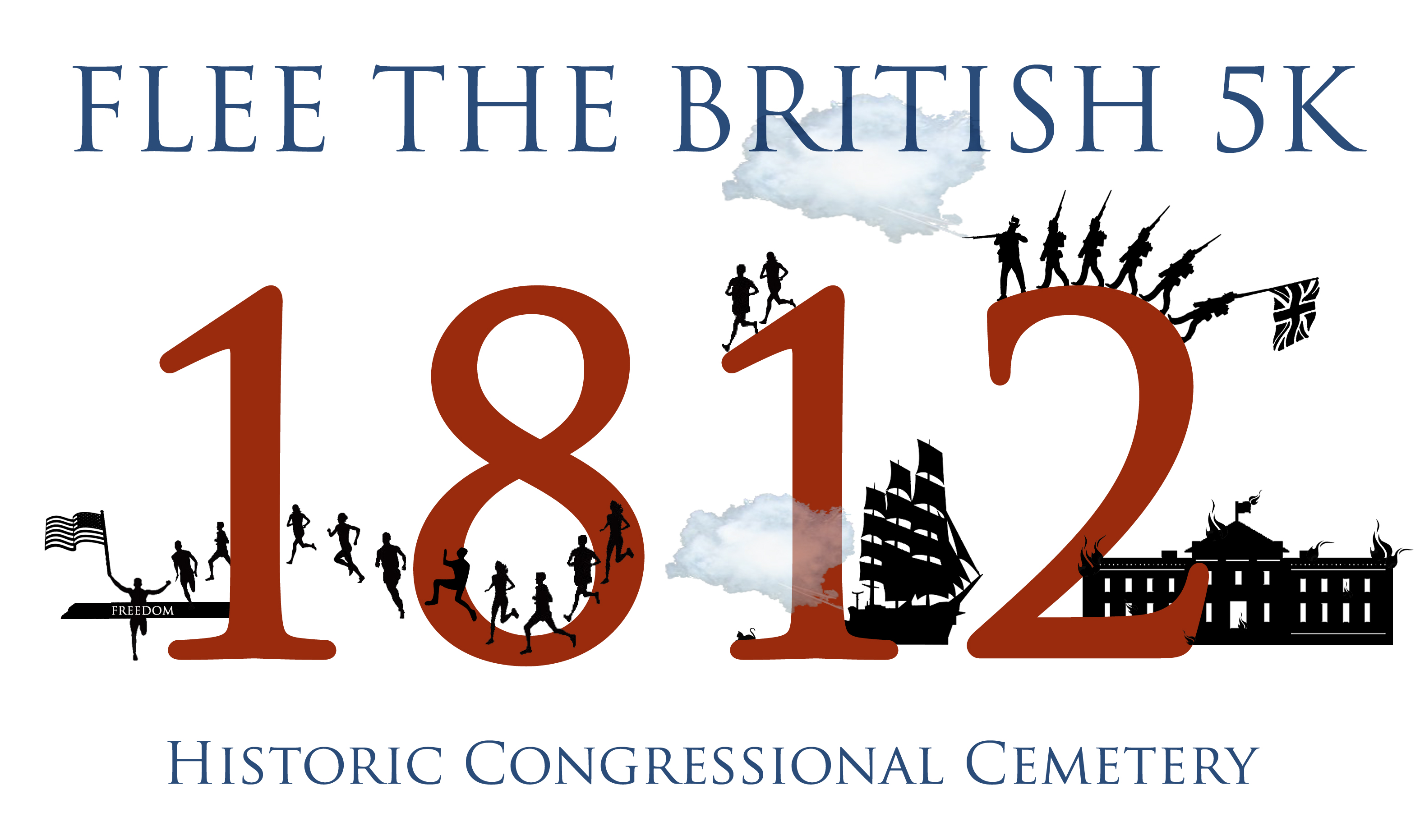
Since his group also portrays both Redcoats and Rebels, I ask him why a Brit would want to portray an American Rebel. “Well,” he says with a sly grin, “you’ve got to have someone to shoot at.” Despite the eventual American victory, “We won a lot of battles,” he says. “You ran from us.” I concede we Yanks have often been quite good at running from Redcoats. In fact, this year in DC on the 200th anniversary of the British burning of Washington during the War of 1812, the Historic Congressional Cemetery held a “Flee the British 5K”, where runners competing in the race were chased by Redcoat re-enactors. (What could be more American than turning your national failures and humiliations into a patriotic way to celebrate your love of country?) The British Embassy, for their part, held a “White House BBQ”. Both were held in the spirit of celebrating the rebuilding of the American-British relationship and 200 years of peace and friendship between our countries. It is nice that we can both share a somewhat twisted sense of humor about our intertwined histories.:)

Run, Americans, run!

Run, Americans, run!

Before we part ways, he cannot resist teasing me a bit about how Americans have butchered the English language. (This really does seem to be the national pastime here.) “And,” he says, “you Americans don’t know how to make tea.” In my case at least, this may be true. My traditional way of making tea is to fill a mug with tap water, put a tea bag into it, microwave the mug for one minute, let it cool for about 5 minutes, and then drink it, leaving the bag in so that I can reuse it several times during the day. Apparently they have some other way of doing it here.

Because I confess to having a terrible sense of direction, he kindly walks me back to my hotel. “Even back home in DC, I get lost a lot,” I lament. “They actually say Pierre L’Enfant designed the city of Washington to be confusing on purpose so the British wouldn’t be able to successfully invade.” “Well,” he points out with a grin, “it didn’t work.”

At the hotel I collect my bags and get a taxi to the train station where I’ll meet my friend. The driver asks where I’m from and then tells me he used to live in America. “I consider myself part American,” he says, which is nice to hear. He tells me that when his family moved back to England, his 12-year-old daughter experienced some trouble from people at her school because she’d developed an American accent. “But the nice thing about having a British accent in America,” he says, “is that you can insult someone and it will take them a few moments to understand what you said, and by that time you’re already far away down the street.” Wow, yet another superpower of the British accent in America that I hadn’t even realized.

I meet my friend at the station and we board a train for Lancaster, which we’ve decided to visit next. I will confess some staggering ignorance here. I grew up in Pittsburgh, in Pennsylvania, a state where there is a town called Lancaster. Until this trip, I did not realize that there was a Lancaster in England as well (nor that Somerset, Lincoln, or Cleveland — all of which I knew as American towns or cities — were also the names of areas in England). Interesting to think that the British colonial legacy has probably shaped our country in many more ways than we even realize.

To pass the time on the train, I try to see how the weather back home compares to the pleasant weather we’ve been having in England. (From what I hear, many people would not use “pleasant weather” and “England” in the same sentence. But it really has been very comfortable so far.) I pull up my phone’s weather app, but for some reason DC no longer shows up in my list of saved cities. “That’s odd,” I muse. “Washington is gone.” My friend, who rarely misses an opportunity to give me a hard time about British-American history, looks over with a grin and says, “What, did we burn it again?” I roll my eyes. “Come on. What would you do if the Brits actually burned Washington again?” He thinks for a moment. “Join ‘em?”

Before I can defend my city’s honor, we arrive in Lancaster, which is a really pretty, very “historical”-looking town, with lovely streets and buildings. After wandering for a bit, we have dinner in a restaurant built in the 1600s (wow!), where my friend turns me on to the awesomeness of ginger beer. I choose the non-alcoholic variety, since I generally don’t care for alcohol, and am instantly hooked. How have I gone my whole life thus far without experiencing this gingery goodness?

Ginger beer!

Ginger beer!

It’s pretty late by the time we finish, and my friend is tired and goes back to his hotel room, but I set off on a quest to find a pub that’s still open and is serving dessert. This journey takes me up and down various winding roads, where I pass many interesting places which seem either too loud or too crowded. Eventually I come to a place called Revolution. Though it has nothing to do with ours, still having history a bit on the brain after the past day, I can’t resist checking it out.

Unfortunately they are no longer serving food, but as I’m about to go, I see they have ginger beer, so I decide to stay for a drink. As I’m standing alone at the bar, a guy next to me asks me a question, and on hearing my accent, asks where I’m from and where I’ve been visiting in the UK. “A lot of nice places,” I say. “Liverpool, Arundel, London, Leicester…” He nearly spits out his drink. “Leicester?! Why would you visit Leicester?” Really, what do Brits have against Leicester? “I liked it,” I protest. “It was very beautiful and had nice historical places and-”. But he’s already turned to his two friends and is telling them, “She came all the way from Washington DC and she visited LEICESTER!” They respond with dumbfounded laughter, agreeing that Leicester is a really terrible place to visit.

I guess meeting a Yank who actually liked Leicester has piqued their interest (or maybe they just feel sorry for me in my incredible naivety), because they invite me to have a drink with them. “So, why were you in Leicester anyway?” one of them asks in amusement. I explain that I was invited there to meet a Revolutionary War re-enactor. “Why are you interested in the Revolutionary War?” the second guy asks. “Well, it led to the birth of our country, so to speak, so it’s really important for our history and identity, and I was interested in how it’s viewed here.” He pinches his fingers together and grins: “We had a little part in that, didn’t we?”

We end up hanging out for the next three hours until about 1:00 AM. I learn that they are all British army veterans, two of whom now work helping disabled vets. They now live scattered between southern England, Scotland, and Wales, and so have met in the ‘centrally’-located Lancaster for their once-a-year one-night reunion. They plan to meet once a year for a special weekend, to each resolve to achieve something on their bucket list for next year, and also to each year donate one item of special personal significance to a box which will someday be passed on to the last one of them alive in their old age. What a cool idea. I am touched by their friendship, and amazed that they are spending their one night a year together talking to a foreign stranger.

One of the guys asks me about the US-UK relationship. “I find it a bit strange, to be honest,” he says. “Britain just tends to go along with America, but America doesn’t really need Britain and yet the two countries are so close.” I tell him my impression is that many Americans still see Britain as family in some way. Maybe this factors even into government relations. We begin talking about British and American cultural differences. “I think the sense of humor is different,” he says. “Americans seem more reserved and super careful not to offend someone. Brits don’t worry about this.” I have my own theory on this, actually. “I think the difference is not so much in the humor itself but in the delivery,” I say. “We both appreciate irony and sarcasm and I think we find a lot of the same things funny. But when Americans are sarcastic, we generally deliver our sarcasm with a smile, or say ‘just kidding’ if the person doesn’t immediately get that we’re joking, so that we can be sure we’re not really offending them. Brits tend to deliver sarcasm deadpan with a perfectly straight face, and sometimes we don’t realize they’re joking.:)”
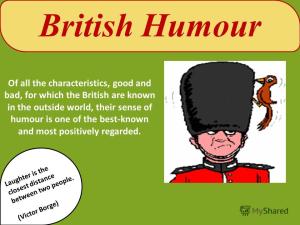
Sarcastic, we are!

Sarcastic, we are!

He tells me about some of his visits to the States. “The first time I visited, I didn’t really like it,” he says. “I didn’t like how people in stores and stuff just say ‘Have a nice day’ to everyone; it seemed fake. But then after I went back a few times, I started to like it because I realized it was actually genuine.” This is interesting to me. Wishing someone a nice day could actually annoy them? “Well, most of the time it’s genuine,” I say. “It’s not just people in stores; if I got into a conversation with a stranger on the street or on an elevator or something I would wish them a nice day when we said goodbye. It’s just meant to be nice.” I tell him I was warned about irritating strangers by talking to them in Britain, but that I’ve found Brits to be very friendly and not at all standoffish. “Like you guys, you talked to me even though you didn’t know me.” “Well, you’re an American!” he says. “If we talked to a UK girl in a bar she’d probably think we were tapping off.” I stare at him, confused. “You know, like bagging off.” Huh? “Oh, you mean like hooking up or picking someone up?” “I guess.” Hmmm, maybe Americans and Brits really do speak two different languages. “This is the first year we’ve had an American in our group. Or a woman,” he adds. “Of course, this is the first year we’ve done this.:)” I am really grateful to them for making me feel so welcome. Before we say goodbye for the night, they invite me to come back to the UK sometime and visit somewhere besides Leicester.

The next day, my friend and I visit Lancaster Castle, a historic castle which served as a prison all the way until 2011, and still serves as a court. We take a guided tour, which culminates in those of us who choose to being locked in one of the old cells, completely cut off from light or sound, to experience what the prisoners experienced hundreds of years ago. (After the guide lets us out, my friend, who didn’t go in, tells me the two of them had discussed heading off to a pub and leaving us there for a bit.) Afterwards we head to the café adjoining the castle for cream tea (which, by the way, is tea served with a scone and cream, and not tea with cream in it like milk tea or bubble tea, which is what I used to think until a British acquaintance in the States explained it to me, while visibly trying not to laugh).
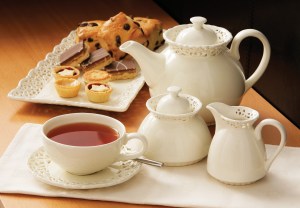
British tea

British tea

Afterwards, my friend goes back to the hotel and I decide to go to Williamson Park to see the Ashton Memorial, which looks pretty in the picture on the guide map. On the way, I get sidetracked by an incredibly beautiful building which looks like a cathedral, but has the word ‘House’ on the outside. This intrigues me because I can’t imagine such a beautiful place actually being someone’s home, so I decide to investigate. I walk up the stairs to the covered ‘patio’ in the front, where two little old ladies are sitting, and ask them what this building is. Turns out it’s a sort of retirement or nursing home, and they actually do live there. “Wow, what a lovely place to live!” I exclaim. “Oh no, it’s terrible,” they both say almost instantaneously. “Eleven years ago it used to be nice,” one of the women says. “But now it’s just full of gossipy women…There are a few men who are okay though…”

The other lady asks me if I’m Canadian or American. “American? Oh, how lovely. Why don’t you sit down and talk with us for a bit?” They seem both sweet and lonely, so I sit down with them, and the one lady, who has lived in Lancaster for 80 or 90 years, begins telling me about the town. “Yes, over there across the way is the Town Hall…Then there’s the Victoria Memorial in the square right across from it…Then right up the street there, there was this very nice young doctor I used to go to see when I was a little girl…He had a table with a big bowl on it and he used to give us fruit and candy…He murdered his wife…She was having an affair…The maid walked in so he had to kill her too…He cut their bodies into little pieces and wrapped them in newspaper, and took them to Scotland, and threw them into a stream, but the newspaper was from Lancaster so they traced him here, and there was an exhibit about him in Madame Tussaud’s Wax Museum in London, and when I went there I saw the same table from his house and the same bowl that I used to eat the fruit from…” By this point I am speechless; I’m not sure what the proper response is to a ‘the nice young murderer who was my doctor lived just up the street’ story. (By the way, I later look up the name she gave me and it turns out the story is true — Dr. Buck Ruxton apparently committed the murders there in the 1930s and was later executed.)

Luckily I am saved from having to think of an intelligent response by the other lady, who turns to me and says, “We think very highly of America. If it wasn’t for your sending food and soldiers during the war…” I’m surprised people still remember that, and though I wasn’t around at the time, I’m happy that my country could do something to help Britain. “Do you like President Obama?” the other lady asks. “Yeah, I like him. I don’t agree with him on everything, but in general I think he’s trying to do some good things.” “We like him too,” she says. “And Clinton. And Kennedy — do you remember him?” “Um, well, he was a bit before my time, but he seemed like a pretty good guy.” “Yes, and I really like Elvis”, she continues, “and Marilyn Monroe…” Since they seem so interested in American stuff, I show them some postcards from Washington DC that I have in my bag and ask if they’d like to have one. “Oh, how lovely. Thank you. Why don’t you write your name on them dear, and your address too, and maybe we’ll write to you at Christmas.” How incredibly sweet! So I do, and write them each a little note saying how nice it was to meet them as well.

At that moment a little old guy comes in and sits down beside us. The one lady turns to him and says, “Have you ever been to America?” “No, I don’t fancy America,” he says. “They’re very backward there.”

We sit and talk for a few minutes more, and then the guy starts talking about 9/11 conspiracy theories, which I take as my cue to leave as I don’t want to get into an argument in front of these sweet ladies. So I bid them farewell, and hope that they include their address if they send me a Christmas card so that I can send them one as well.

I set off again toward where I think the park is, but get sidetracked again, this time by a path going off into the woods. I love to walk on paths through the woods. I promise myself I’ll just stick to this one path, just for a few minutes, and not turn off anywhere, as I want to get to the park before dark. About six turns and six paths later, I find myself on top of a very steep, almost cliff-like hill, with a gorgeous view of the memorial right in front of me, but no way to walk up to it. I decide to see if I can climb down the other side of the hill. I make it about halfway down before I slip and end up falling the rest of the way down. At the bottom I pick myself up, covered with dirt but uninjured, and gaze up at the memorial which is much, much, much bigger and more impressive than it looked from a distance. I can’t remember who Lord Ashton was, but he sure has an awesome memorial. I climb to the top of its massive steps, and can see through the window that there’s a wedding reception or something going on there. So I wander around for a bit outside, and watch the sun begin to set over the beautiful valley below.

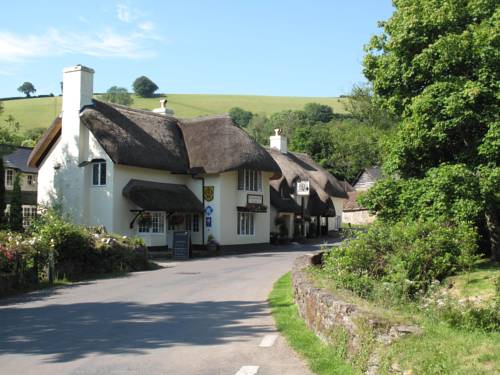
British countryside

British countryside

I decide to try to find the traditional exit instead of trying to climb back up the hill and back into the woods. When I find my way out of the park, I remember one of the ladies had recommended me to visit Lancaster University and decide to give it a try, but I realize I have no idea where it is. I stop two people walking their dog to ask for directions. The man frowns. “It’s a bit far,” he says. “Three miles at least. It’d probably take you more than an hour to walk there.” I ask them how hard it would be to get a cab around here, and the woman says, “Well, this is our house across the street. Let me just put my dog inside and then I can drive you in my car.” “Oh, that’s so kind of you, but I couldn’t possibly”, I start, but she insists it’s no trouble. So we get in her car and she actually drives me to and all around the campus, pointing out the different buildings and places of interest, as she used to study there.

I can’t believe she’s going so out of her way to do something so nice for a complete stranger, and thank her profusely. “People sure are friendly here.” “Well, there’s a bit of a North-South divide,” she says. “People in the South think we up North are a bit silly…Am I driving on the right side of the road?” She is driving on the right side of the road, and it looks right to me, but I’m an American, and this is Britain, and I’m pretty sure they drive on the left here, so probably she should be on the left, unless this is a one-way street, only I can’t tell for sure because they have these funny things called roundabouts instead of stop signs and it’s confusing. “Um, well, maybe you want to be on the left side.” “Yes,” she agrees, and changes lanes. “I just got back from visiting France and I got used to driving on the right there.” I can empathize, as the first time I drove in the States after returning from living in Japan, I drove on the left side of the road because that’s how the Japanese do it, causing no small amount of distress to my passenger. I make sure my seat belt is fashioned extra tightly, but we make it through without a problem, and she insists on driving me all the way back to my hotel. What an incredibly nice woman. I wish I could do something in return, so I give her my card and tell her to please look me up if she’s ever in DC.

The next day, unfortunately, is my last in the UK. It takes us about six hours to get back to London from Lancaster. During a layover at Liverpool station, I console myself by getting a pasty. When I’m done, I hunt for a rubbish bin, but can’t find one. “Just leave it on the table,” a group of guys who appear to work for some company in the station tell me. However, after taking one look at the consternation on my face, they actually produce a garbage bag from their supplies and tell me I can put it in there. As I gratefully do so, one of the guys says, “You could have just left it on the table like that other person did,” pointing to some garbage left on the next table. So I throw that into the garbage bag too, and they look at me with great amusement.

Back in London, before we part ways, my friend takes me to see the Royal Courts of Justice. Very impressive architecture and beautiful gardens. Almost makes one want to get arrested for something in order to get to spend more time here, but I decide against that. Still, how amazing to just walk through the middle of downtown and see such beautiful and historical places.

What a truly wonderful trip. Before I came I loved Britain as family, despite not having spent a whole lot of time here. But now I love it on its own merits as well. It is a lovely country, with beautiful towns and cities (including Leicester-just accept that, Brits!), amazing and well-preserved history, a highly convenient train system and a prevalence of visitor centers and tourist maps that even a directionally-challenged Yank like me can understand, and wonderfully kind and interesting people. And it is a country I think my own will always be linked to in a special way. America’s and Britain’s histories, present, and future seem destined to remain intertwined. In some ways both countries are who they are in part because of the other, and in engaging with each other we learn more about both who we are and who we are not. In some way I feel like some small part of me belongs here, even though my home will always be across the pond. And I feel like on some level Britain has accepted me, and that’s perhaps the nicest thing of all.
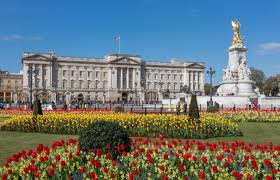
Buckingham Palace

Buckingham Palace

It’s starting to get late, but I have about an hour to kill before heading back to my friend’s flat for our final dinner together. Buckingham Palace, which I haven’t seen in years, is within walking distance from her place. But I’d rather spend my last moments here among the “real” Brits, so I wander around the neighborhood for a while. I end up by the Chelsea Bridge and Battersea Park. By this time tomorrow I will be home. It’s always nice to be back in my beloved America. But I will miss Britain terribly too. I look out on the water, the night lights of London dazzling in its reflection. “I love you, Britain,” I say silently. “And I’ll be back. I promise.”

Posted in Travel | Tagged , , , , , , , , , , , , , , , , , , , , , , , , | 4 Comments

Desperate English Housewife in Washington, chapter 509

Pumpkin carving

This is a big deal in America. I shan’t show you my poor effort. It’s just sad. I won’t be entering any competitions, put it that way.

But look at these! Amazeballs!

Genius

Genius

Ace

Ace

Wowsers

Wowsers

Love!

Love!

My fave!

My fave!

Reflections on the UK, part 3

Here  is the penultimate installment of American blog reader Rebecca’s visit to the UK.

You can catch up on parts 1 & 2 previously if you missed out!

Part 3

I set off for Hyde Park, which I have always wanted to visit.  It is much bigger than I realized and very beautiful.  I wander around for a few hours, and come across the 7/7 memorial to the victims of the 2005 terrorist attacks on the London subway (tube).  It is simple and solemn.  I feel a pang of sadness—especially as British lives lost are like the loss of family—and take a moment of silence and say a prayer that Britain will be safe and happy and at peace, and throw in the same prayer for America too.  I continue walking, end up in Kensington Gardens, and accidentally discover the Albert Memorial, which is amazingly beautiful and huge.  I search around but cannot find any inscription explaining who Albert is or why he gets such a cool memorial.  Later that night, I ask my friend’s husband and he tells me Albert was Queen Victoria’s husband, which makes him a prince and not a king, for reasons which are unclear to me.  (Some time ago I gave up any real attempt to understand the differences between the different titles (Earl, Duke, Lord, etc.) and the rules of royal succession in Britain.  At some point we all must learn to accept our limitations.)

Kensington Gardens

Kensington Gardens

My friend decides to cook a special dinner and the three of us sit down to eat together.  We begin talking about our work.  She periodically meets immigrants from places like Portugal  who were doctors in their own country, but have to take menial jobs in England because they don’t speak English well enough.  Having lived in Japan, I can sympathize —my Japanese is advanced but not fluent, and had I not been teaching English my job prospects would have been much more limited.  “I remember how humiliating it was when I had to go down to the immigration office in Tokyo once and couldn’t understand all of what was said to me; it made me feel stupid.  But it gave me a greater empathy for people who come to America and can’t speak English well.”  Here, my friend’s husband breaks in with an almost incredulous grin:  “People in America who can’t speak English well? Those are called Americans!”

Ah yes, there it is.  As far as I can tell, in order to maintain British citizenship, it is a requirement that you must mock Americans’ English on a regular basis.  While studying at a Japanese university for a year, I had a British professor for a history course taught in English to a mixture of Japanese and foreign students.  Very nice guy, who scarcely let a class go by without finding some way to get a dig in about Americans’ language skills.  The day before a big test, he announced to the class: “For my Japanese students, you can bring your English dictionaries to the test, in case there are any words you don’t know.  And my American students, you may bring your dictionaries as well, since I know you have difficulty with English.”  Later that year, by complete coincidence, I met Jeremy Bulloch, the British actor who plays Boba Fett, my near-favorite character in the original Star Wars trilogy (after Vader, of course).  Naturally this excited me, and we got into a conversation.  He was incredibly nice, down-to-earth, and talked to me for about 20 minutes.  At the end, I thanked him, and he said, “Good luck studying Japanese, that’s a challenging language.  And good luck studying English, I know that’s hard for Americans.”  Et tu, Boba Fett?

Much as I would like to prove him wrong, I don’t end up making my case very well.  We get into a discussion about parking tickets.  He detests the parking attendants who give them.  “They’re evil,” he says, “right up there with Peter Files and terrorists.”  “Who is Peter Files?” I ask, wondering who could have done something so terrible as to be lumped together with terrorists (and apparently, parking attendants).  Moments after the words leave my mouth, I realize too late that he was saying, with his delightful British accent, ‘pedophiles.’

They ask about my plans for tomorrow, and I tell them I’m planning to go to Leicester, prompting some raised eyebrows.  “Leicester?  What’s in Leicester?  Nobody goes there.”

I’m actually going there to meet an officer in the British army.  The Imperial army, that is.  He’s a historical re-enactor who runs a group which does battle re-enactment and living history events of the Revolutionary War (or American War of Independence/AWI as it’s called in Britain).

I became exposed to the concept of historical re-enactments this summer when various nearby American towns which experienced battles or occupations during the War of 1812 marked the bicentennial.  Re-enactors portrayed various battles between the American and British forces, and many towns also used the occasion to celebrate 200 years of peace and friendship between America and Britain (including DC, though happily they didn’t re-enact burning the White House).  At first I found the idea of re-enacting a war a bit strange, even worried it might be trivializing a real-life tragedy where many lost their lives.  However, through witnessing it firsthand and talking to the ‘soldiers’ who painstakingly research the history in order to accurately portray and share it with the public, I realized it can be a valuable way of preserving history and educating others about it.  In researching some of the events, I came across this group in Britain which re-enacts AWI battles, portraying both the ‘Redcoats’ and the Revolutionaries.  Intrigued, because I understand the Revolutionary War to be not a very big deal in Britain, I contacted one of the group leaders, and he’s invited me to meet.

I’m excited to get to see somewhere in England outside of London and Oxford (the only two places I’ve been on previous trips), though when I ask my British friend in DC whether he’d recommend Leicester as somewhere to visit, the answer is an emphatic NO.  But I take the train about an hour from London anyway, and am greeted at the Leicester station by the re-enactor, who takes me on a short walking tour of the city as we talk.  (Awfully nice of a Redcoat to be so welcoming and courteous to a traitorous Yank.)

I quickly fall in love with Leicester.  It has beautiful, historical-looking buildings, cobblestone-ish streets, and a very ‘English’ feel to it (or at least what I imagine one to be) which instantly brings forth my affection.  After stopping to see the Jewry Wall, which is apparently the tallest surviving Roman structure in the UK, and dates from the first century AD, we go to a coffee shop to continue our chat.

I’m interested in how the Revolutionary War is thought of in Britain.  It’s not thought of much, he tells me, as Brits don’t learn about it in school.  But he became interested in it because of his interest in 18th-century history and started to study it on his own.  The re-enactors in his group portray both the British and the American forces, speak to the visiting public about the war from each perspective, and work to create an immersive experience, sometimes even camping out at the battle sites with their ‘regiments.’  There are also online chat forums where re-enactors from both America and Britain discuss the war and means of re-enacting it, down to the minutest detail of the uniforms.  They generally don’t bring politics or ideology into it, he says, but just want to better understand and preserve history.

He poses the question of how the Revolutionary War has influenced current politics.  “I think it’s influenced current identity and views about the other, at least in America,” I say.  “Of course the Revolutionary War was a critical factor in giving birth to America and shaping its identity.  I think it has shaped our values still today, in that we’re proud of our independence, love freedom, and still sort of have a sense of rebelliousness and rooting for the underdog.  But despite having fought for independence I think a lot of Americans today do have some sense of special affection for Britain, and some see it as our family or parent in a way.”  (At least that’s my impression.  The most touching way I’ve heard this expressed was by an American reader commenting on a British article on the US-UK relationship, who said: “Let’s remember you (Britain) are our mother, speaking as an older American.  We’ve died for you and we’d do it again if necessary.”)  “And my perception is that some Americans still seem to sort of ‘look up’ to Britain in a way, like sort of seeing it as a symbol of culture and sophistication…The American public broadcasting stations, for example, show almost nothing but British shows, like they see it as a higher form of TV….And of course, in many American movies the most intelligent people have a British accent 😉 …Maybe in some ways that’s the dual legacy of the colonial history in America—treasuring our independence but still feeling linked to Britain.”  We talk about the current popularity in the States of British shows like Sherlock, Dr. Who, and Downton Abbey.
Ugh.

Ugh.

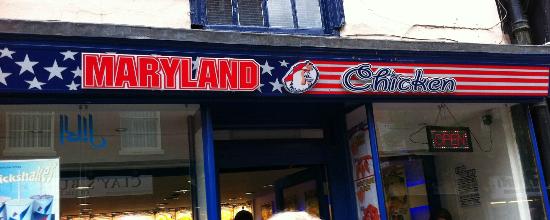
On the flip side, he tells me about the popularity of American culture (TV, food, etc.) in Britain, particularly among younger people like us.  In his view, British and American culture have become ‘integrated’ in a way.  (As if to illustrate this point, as I look up I see a Maryland Chicken shop across the street, with a big American flag on its sign.)  “Do people resent that?” I ask shyly.  I’ve read about some Brits lamenting the ‘Americanization’ of British culture.  “No, not at all,” he says.  We begin talking about the TV shows we like, and he mentions he’s currently hooked on the new House of Cards.  A British show popular enough in America to inspire an American version which is now being watched in Britain.  Perhaps our cultures really are becoming integrated.  (Any lingering doubts about this are somewhat erased later in the trip when, as I’m watching the season-opening episode of Downton Abbey (don’t hate me, fellow Americans!), a commercial for Virgin Trains comes on whose new slogan is centered around what I always thought was the most quintessentially American slang: “Arrive Awesome.”  Which is rather awesome.)

As we get up to leave, I think about how if America and Britain could go from being bitter enemies to such close friends, surely there is similar hope for other countries currently in a state of animosity or war.  Perhaps that’s reason enough to preserve the memory of the Revolutionary War.

He leaves me off at the Globe, a pub dating back to 1720, where Redcoats used to recruit in the 18th century.  Naturally I can’t resist eating lunch there.  Since I generally don’t drink alcohol, I wasn’t sure how well I’d fit in in a pub, but the food is good, and the people are friendly.  As I go to pay, the bartender compliments my Nintendo T-shirt, and we get into a great discussion about gaming.  While washing my hands in the toilet, a woman comes in and begins chatting to me about the nose piercing she’s just gotten.  It makes me feel like I’m back in America, where I’ve had many a friendly conversation with random strangers in public bathrooms. Where are all the surly people the Brits keep warning about?  It’s just like back home, except they have cooler accents.

leicester

I spend the rest of the afternoon wandering around Leicester, which I find beautiful and endearing because it seems like more of a ‘regular’ English city, not a tourist attraction—the kind of place I’ve been wanting to get out of London to find.  I visit Leicester Cathedral and see the new place they are building at the altar to inter the recently-discovered remains of King Richard III.  I visit the Town Hall and the remains of Leicester Castle.  I wander clear off the map of the city I’ve gotten and struggle to find my way back.  I love every moment.  I can’t fathom why Brits seem to be so down on visiting Leicester.  As I head back to the train station I get a wicked craving for ice cream.  Remembering the food at the previous pub, I pop into the next pub I see to see if they have any.  The bartender looks at me sort of pityingly at the apparent absurdity of this question and says with a grin, “How long have you been in England?”

Posted in Travel | Tagged , , , , , , , , , , , , , , , , , , , , , , , , , | 1 Comment

Desperate English Housewife in Washington, chapter 508

Today in America

I realised that I can’t get used to calling ‘kitchen roll‘ paper towel.

I learned that whilst we Brits call this thing -1 ‘minus 1’, Americans call it ‘negative 1’.

I learned that American Fall can be 80 degrees (today) or it can be 45 degrees with snow flurries (Saturday).

I realised that very few Americans have heard of Boxing Day.

I assured an American that, yes, we do have Christmas Eve.

I also explained that we don’t have Thanksgiving in the UK.

🙂

Reflections on visiting the UK

Part 2

This is the second installment from American blog reader Rebecca Cataldi, who took a recent trip to Britain. (Read the first part here.)

I am a little shy about my American accent. I like the American accent. But like many Americans, I adore the British accent. Yes, I know there are in fact many different British accents. But it really doesn’t matter to us—from the most elite to the most uneducated, most all British accents sound so cool, so intelligent, cultured, sophisticated. I think a British accent is one of the most beautiful sounds in the world. (Eventually, this will likely get me in trouble. ‘Hmmm, that guy beckoning me into that dark alley is holding a bloody knife. But he has a British accent, so he must be trustworthy.’ But I will enjoy the melodiousness in the meantime.) I’m not sure what an American accent sounds like to the average Brit, but somehow I’m guessing it doesn’t have quite the same effect. My friend in London says it was really hard for her to get a job here at first because of her American accent, and that while she now has a job she loves and most of the people are wonderful, there are still a few elite clientele who talk down to her or treat her as less intelligent when they find out she’s American. On the other hand, a British friend in the States has gotten out of speeding tickets when he was clearly in the wrong at least three times, as the cop became enchanted upon hearing his British accent. (Brits in the States, you possess a superpower when you open your mouth—use it wisely!)

;)

😉

The next morning, I go to wash up (oops, scratch that, in Britain washing up means to wash dishes, not wash your face), and discover that there really is a separate spigot in the sink for hot water and one for cold, so that you may choose between freezing or scalding yourself. I’m not sure what the reason for this is, but since the Brits sound so intelligent when they talk there must be a good one.

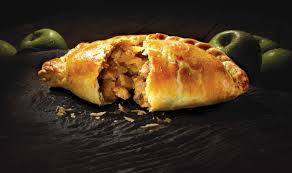
I start off my day in London by taking care of a top priority—getting a pasty. Oh, how l love the taste of British pasties. Before the week is over, I will try many new delightful British foods for the first time as well—steak and ale pie, poacher’s pie, Lancashire hotpot, Sunday roast, Lancashire toad (for some reason this is a name for something with sausage in it), and a Whitby (Yorkshire) pudding (a most confusing term to an American whose mental image of pudding is a chocolate mousse-like substance eaten from a plastic Jello container). And a favorite, the sausage rolls. (These are amazingly wonderful. Why don’t I ever see these in the States? I resolve that this must be rectified somehow.) Also, a dessert called Eaton Mess, which gives me a wickedly wonderful sugar high. I will probably have to hyper-exercise for the rest of my natural life to make up for whatever weight I’m gaining, but it’s totally worth it.

Good old British pasty!

Good old British pasty!

On previous visits to London, I have gotten to see many cool famous places, like the Tower of London, Westminster Abbey, Buckingham Palace, and Trafalgar Square. (Trafalgar Square still brings forth two age-old questions which I have not yet been able to find the answers to: (1) Why is there a statue of a giant blue chicken? And (2) Why is there a statue of George Washington? Of course, I think he’s a pretty great guy, but I just didn’t think he’d be someone the Brits would give a place of honor to. I remarked on this once to a British friend in the States, and he suggested that maybe there should be a statue of King George III put up next to the White House. Wonder how the Tea Party would react to that…)

Anyway, this time I’m ready for something different, so I set off for the London Dungeon. It is close to the London Eye — the big Ferris Wheel by the river — so I set off in that direction. Along the way, I try my best to practice using proper British English. I ask for lifts instead of elevators, look for car parks instead of parking lots. I even fight the temptation to seek out a garbage can and ask for a rubbish bin instead (though that term sounds sooo odd in an American accent). However, my valiant attempts at linguistic savy-ness are thwarted when I arrive at the Dungeon and ask the creepily-dressed staff person, “Is this the line here?” “Yes, that’s the London Eye,” she says politely, pointing across the walkway. Oops, guess I was supposed to ask for the queue (which, by the way, is pronounced “Q” and not “kway”, as I used to think.)

London, innit

London, innit

In American terms, the London Dungeon is something like a cross between a Disney World attraction and a Halloween haunted house, except that it’s designed to let you experience London’s history at its creepy best. Upon entering, we are all declared traitors to King Henry the 8th and taken through the site of Guy Fawkes’s execution, a medieval torture chamber, a hospital where Plague patients are treated, Sweeney Todd’s barbershop, the site of one of Jack the Ripper’s murders, and a few other places, culminating in a courtroom where we are all sentenced to death and ‘hanged’ via a freefall ride. Being someone who both loves the creepiness of Halloween and is interested in history, I absolutely love it. The one thing that impresses me most that I haven’t generally come across in similar attractions in the States is that they have somehow managed to infuse parts of the dungeon with the smell of decaying rat carcasses. It is the kind of smell that gets up into your nostrils and is actually a little stomach turning. Well played, London Dungeon.

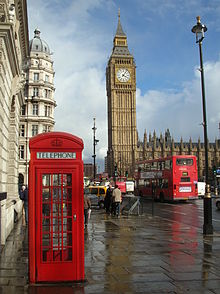
When I get out, I find myself by the river’s edge, staring up at Big Ben and Parliament and the bridge and the Union Jack overlooking them all, to me the quintessential symbols of Britain, looking so grand and majestic, and think, “Great” Britain indeed.

Part 3 to follow!

Posted in Travel | Tagged , , , , , , , , , , , , , , , , , , , , , , , , | 7 Comments

Desperate English Housewife in Washington, chapter 507

Explaining The Sun’s Page 3 to Americans

I can’t really remember how this conversation came about, but when you start explaining (not condoning, just explaining) The Sun’s Page 3 to Americans, which lands on a soft-porn daily basis on the breakfast tables of many British homes, it all seems quite bizarre and outdated.

‘So, it’s a picture of a woman with her boobs out in a newspaper?’
‘Er, yes.’
‘And people just read this and look at the picture?’
‘Er, yes.’
‘And it’s sold in shops?’
‘Er, yes.’
“Top shelf, though?’
‘Er, no.’
‘How very European.’

😉

This is how The Sun looks on page 2 & 3 - boobs aren't usually blocked out tho! ;)

This is how The Sun looks on page 2 & 3 – boobs aren’t usually blocked out tho! 😉

Trick or Treat

Americans keep asking me if Halloween is the same back in the UK as it is out here.

My answer is ‘nope, not in the slightest’.

And these fabulous British gents confirm it. 🙂

Fun and sexy Halloween style

It is that time of year again when the kids get excited at the idea of Trick or Treating and adults have a chance to dress up in outfits they would not normally consider during the rest of the year. Yes, it’s Halloween.

I’ve already had one Halloween party, and three more to go this year! Yes, really! So, what will I wear?

Have fun with costumes

There are two types of costumes for Halloween – those that have to do with horror and those that have nothing to do with it. With the former type, Halloween outfits have become a challenge, with party guests trying to outdo each other in the sophistication of their costumes. In the latter, partygoers simply have a choice to dress up in the costumes they have always wanted to wear, whether it is in homage to a favorite actor or musician, or in outfits that show off their wild side.

Celebrating Halloween is a great reason for having a party, especially as no one expects such an event to be a formal affair. Forget the little black dress that gets rolled out for other functions. If you are going to a Halloween party, you are going to have to put some thought into what you are going to wear; and for many, this is the most fun part of holding or going to a Halloween party – but where do you look for inspiration?

Hunger Games stylie

Hunger Games stylie

Movies can provide you with plenty of ideas for costumes. Sci-fi films will have some great and unusual costumes such as those worn in The Fifth Element or The Hunger Games. Think retro and go back to the 70s and 80s by dressing up as Wonder Woman or Supergirl. Always wanted to be a princess? Watch Disney animated films for costume ideas such as Ariel from The Little Mermaid or Rapunzel. Alternatively, come up with your own creation. You can be a phoenix or a peacock with the application of feathers, and a fairy or pixie with the addition of wings. Beautiful!

Is the party a fun time for adults? If so, then you should see it as a chance to go sexy (I’ve seen a lot of this so far this Halloween season! It is now common for women to dress up as sexy versions of police officers, nurses, firefighters, and even, if you can believe it, sexy zombies. Is there such a thing? Sexy Halloween costumes all seem to have one thing in common – short skirts, bustiers and knee-high boots. You can browse club dresses and sexy clothes and find the one that suits you best.

The Halloween bunny costume (adults only!)

The Halloween bunny costume (adults only!)

Is the party a homage to the supernatural? If so, a bed sheet for a ghost costume is not going to cut it. Instead, dig out some old clothes and distress them to look even older; suggest dust and decay by sprinkling them with talcum powder. This also works for an undead or zombie costume. If you are planning to wear makeup to complete your costume, ensure that you buy brands that are suitable for the face, as you do not want to be paying for buying cheap face paint by a breakout that lasts for days.

You may be demure the rest of the year, but a Halloween party is a chance to show off your fun and sexy side, so make sure you make the most of it with a sexy Halloween-inspired costume. Fact.

Posted in Travel | Tagged , , , , , , , , , , , , , , , , , , , | 6 Comments

Desperate English Housewife in Washington, chapter 506

Dates USA style

Oh, I can’t do this month/day/year thing that Americans do. I can’t. It just feels muddled in my British head.

Harry has been taught at school to write the date this way, and when I told him that in the UK next year when he returns he’ll have to write it as day/month/year he rolled his eyes. ‘Why is it different?’ he asked, exasperated.

Um, I don’t know.

But, to make sure I don’t get it wrong, I write the date like this: 27 October 2014.

date

Reflections on visiting the UK

One of my American blog readers Rebecca Cataldi, took a recent trip to Britain and I asked her to document her visit, as I wanted to find out her view of the UK through her American eyes.

This is the first installment of Rebecca’s visit:

Musings of an American on Visiting the UK

Since I first visited Britain at age 15 (18 years ago), I’ve felt a special affection for the country.  It’s not anything specific really; it’s more like, as an American, I feel like Britain is our family in a way because of our history.  I don’t have any British blood (in fact, some of my ancestors were Native Americans who did not fare particularly well under British colonization), but British colonialism, and eventual American rebellion against it, played a critical role in our formation as a nation.  So I feel like Britain is our parent in a way, or at least a cool older brother who lives far away but lets you visit occasionally.

That old war thing....

That old war thing….

As I prepare to go to Britain for my first real visit in nine years, I wonder what the Brits think of America.  Do they feel any kind of familial connection as well?  Because I enjoy reading British blogs and web posts, I’ve seen a gamut of opinions expressed by Brits about Americans, ranging from affection to…well, some not-as-nice things.  They do seem to love making fun of us, but in Britain this can be a form of affection (and I’m not always astute enough to be able to tell the difference).  At any rate, I am really really excited to have a chance to go back to Britain for a whole week (yes, this is a long vacation for an American) and hopefully get to understand this place I love a little better.

Before I go, a British friend who now lives near me in the Washington DC area gives me a tutorial on how to properly pronounce British place names that commonly lead Americans to embarrass ourselves when we try to say them.  This is more for his own entertainment than to help me, but I accept the offer because I don’t want to sound like a clueless tourist.  “Glosster”, not “Glowchester”, I repeat obediently, as he sounds out “Gloucester” for me.  Leicester is pronounced “Lesster”, not “Laysesster”—understood.  It’s the River “Tems”, not “Thaymes” (Thames)—fine.  And Southwark has a silent “w”.  Okay—wait, huh?

Gloucester - hard to pronounce!

Gloucester – hard to pronounce!

Having traveled widely abroad, including places like Pakistan and Yemen, I understand the importance of culturally-appropriate dress.  Just to be sure, I ask him, “Is it okay to dress in Britain the way we would here?”  “Sloppy?” he asks, without missing a beat.  Hmmph.

I’ll be staying with a friend in London for the first half (though mainly going around by myself since she has to work), and then later meeting up with my British friend from DC who will be coming to visit family in the UK.  Upon arriving I feel a kind of euphoric joy to be back in Britain, and so the 50 or so Union Jack flags adorning the ceiling of Victoria Station make me smile.  I like the sight of this flag because it symbolizes a country that I love, almost as much as I love my own country’s flag.  I like patriotism.  Not to be confused with nationalism, where you think your country is superior and that its interests are more important than the needs of others.  The world could do without this thinking.  But patriotism is based on love—love for something beyond oneself, love for your country and the values it aspires to, which includes celebrating all that’s beautiful about it and working to improve what’s not.  When I protested the Iraq War in college, it was motivated not only by concern for the impact on the Iraqi people but by patriotism—by the desire for the America I love to act morally and to be a good global citizen and neighbor.  So British expressions of patriotism—though said to be rarer here—make me happy, and the fact that the first thing I see on arriving in London is the Union Jack fills me with delight.

Union Flag

Union Flag

Before attempting to find my friend’s apartment (which I will call a flat for the rest of the week as I want to try, however feebly, to use the proper British words for things while I’m here), there is a more important matter to be taken care of.  I locate the bathroom (sorry, toilet) in the station and am amused to discover that you really do have to pay money for a public toilet.  In America this would likely lead to outrage.  I thought Britain had higher taxes and a larger welfare state than we do.  Why does this not extend to providing free access to public toilet facilities (especially given the potential alternative)?  Oh well, I need to start figuring out what each of the different British coins are worth anyway.

Upon entering, I also discover that, as Brits who come to the US often point out, unlike American toilets the stalls do not have gaping spaces between their walls and the walls extend almost to the ground.  From the standpoint of providing greater privacy, this is admirable and appreciated.  However, if, like me, you are prone to irretrievably locking yourself in toilet stalls when you travel abroad, the lack of room for a ‘crawlspace’ at the bottom can be problematic.  I have done this on several occasions, most recently in Egypt, where I could neither get the stall door unlocked when it was time to exit nor crawl out underneath the too-low wall.  I eventually escaped by climbing on top of the toilet bowl, hoisting myself on top of the stall wall, and flinging myself over the side into the next stall (narrowly missing landing in the squat toilet there).  Happily though, this door opens when it’s time to unlock it.  Bless you, Britain, with your escapable toilets.

Gappy doors USA-style

Gappy doors USA-style

When I finally get to her flat, my friend and I have a happy reunion, and stay up talking til the wee hours of the night.  She married a Brit and has lived in London for the past six years.  I ask if there is any ‘etiquette’ I should be aware of here; anything Americans might normally do that’s considered impolite here, for example.  “Don’t talk to strangers,” she says immediately.  “They will find it rude or annoying.  People don’t like to be approached by someone they don’t know.”  Actually I’ve seen numerous Brits write about this as well, saying that they find Americans sometimes “too friendly” with our tendency to smile at strangers in the street and strike up random conversations with people we don’t know.  Brits, they write, almost take pride in being surlier.  I imagine this may be hard to get used to, as I often enjoy having random conversations with strangers, but I don’t want to irritate my British cousins so I will try to be on my best behavior.

The next installment will be in the next blog! 😉

Posted in Travel | Tagged , , , , , , , , , , , , , , , , , , , | 2 Comments

Desperate English Housewife in Washington, chapter 505

Halloween!

Oh my, Americans love Halloween and they totally know how to make it a celebration! It’s the dressing up bit that the adults seem to love even more so than the kids.

And they rock it 🙂

This.

This.

And these folks.

And these folks.

And all these peeps. Such effort!

And all these peeps. Such effort!

Dudes.

Dudes.

An eclectic mix. From Game of Thrones to Robert Palmer's girls!

An eclectic mix. From Game of Thrones to Robert Palmer’s girls!

That's me in the middle!

That’s me in the middle!

:)

🙂

Smashing!

Smashing!

What amazes me is the creativity and extremes people go to here for their Halloween costume.

This is my friend Justin as Britney Spears in her breakdown phase.

Justin as Britney

Justin as Britney. No cars were actually damaged in this recreation.

He even shaved his legs and bought a green umbrella specifically to recreate this image! Amazeballs!

Is that the real Britney?

The real Britney breakdown

Halloween is not all about trick or treating here. And it’s not all about the kids.

It’s about another excuse to party and to dress up. And why not?! I’m all up for that! 🙂

I hope to bring the extensive fun of Halloween that the USA embraces back to the UK next year, so I hope y’all ready to PARTY!

Posted in Travel | Tagged , , , , , , , , , , , , , | 7 Comments

Desperate English Housewife in Washington, chapter 504

American school date

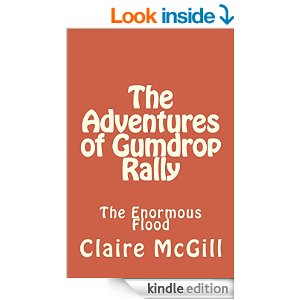
This week I went into Harry’s USA school to read my children’s book ‘The Adventures of Gumdrop Rally‘ to his class.

My kids' book!

My kids’ book!

Gumdrop Rally, the hero

Gumdrop Rally, the hero

You can find my book here. (And top marks to the folks who buy it on either Kindle or Paperback and spot the four typos! Grrrrrrrrr. 😉 )

Anyway, they learned stuff, and I learned stuff too, which is always a bonus!

They learned about the RSPCA, the floods in Gloucestershire of 2007, how long it takes to write a book, and what the word ‘pregnant’ means. (They giggled a lot at this 🙂 ).

I learned these things:

Hedgehogs

A hedgehog called Slow Poke features in my book. Interestingly, I had to explain about hedgehogs since there are no living species of hedgehogs species native to the Americas.

Ain't he cute?!

Ain’t he cute?!

Gooseberries

The kiddos hadn’t heard of gooseberries (Slow Poke lives under a gooseberry bush, naturally), even though (as I found out later) they are native to northeastern and north-central United States and adjacent parts of Canada.

Gooseberry Fool

Gooseberry Fool

I told them I would bring some back and make Gooseberry Fool for them from England.

Questions

This was an interesting question ‘How many dollars have you made?’ I told them so far I’d made £1.26, and that was from me and my mum and dad buying copies. 🙂

Pat or patch?

The music teacher in the class that I sat in on was asking the teaching to ‘patch’ their knees (tap/pat on them). Is this an American thing? I had not heard of this before. Always learning, see?!

What are you doing?

Listen to this accent change! Excellent work!

http://youtu.be/Z5M2HjTlAf0

Posted in Travel | Tagged , , , , , , , , , , , , , , , , | 5 Comments

Desperate English Housewife in Washington, chapter 503

Confusion about undertaking!

In my last post I ranted about ‘undertaking’ on the USA roads. Some people thought I was talking about funeral homes (WTF?!), or they thought undertaking was just like overtaking. Mais non!

Undertaking is this: To overtake a vehicle on the wrong side. Dangerous, and illegal in many countries, especially Germany where Autobahn (motorway/freeway) laws are extremely strict. It is the favourite activity of Audi man, usually at dangerous speed. Audi man will also cut you up afterwards.

In the UK, where one drives on the left and overtakes on the right, passing on the left is undertaking. So, in the USA, undertaking happens on the right of the car and it DOES MY HEAD IN!

(But……. I confess that I do do it sometimes when needs must – much to the shock of my parents when they came to stay!)

The End.

Insight into Elementary School

Harry tells me that the girls at school mostly fart at lunch.

He says he doesn’t know when English girls fart, though.

Well, I guess he’ll find out next year. 🙂

I think she probably just let one slip....

I think she probably just let one slip….

Halloween is almost here

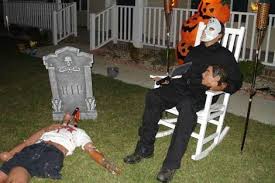
These are some of my favourite Halloween house decorations so far this year!

Americans sure know how to rock this Halloween thing!

Genius

Genius

Freaky!

Freaky! 

:)

🙂

Arty!

Arty!

Amazeballs

Amazeballs

Love this!

Love this!

Whoa!

Whoa!

Posted in Travel | Tagged , , , , , , , , , , , , | 4 Comments